Recently viewed

Find the right combination of North America LTL freight services

Manage spend without sacrificing speed

With the growth of ecommerce, flexibility is in higher demand than ever. With less than truckload (LTL) shipping services, we can help you adapt—creating a true competitive advantage.

Essential solutions for every shipment

Expedited LTL

Meet even the tightest deadlines with our range of expedited options, including charter, commercial air, and air cargo solutions.

Common carrier LTL

Proactively address any challenges with comprehensive coverage based on your specific LTL cargo requirements.

Consolidation

Consolidate your LTL orders with other goods on the same route—reliably and safely, so they arrive on time in full.

Explore consolidation services

Temperature controlled LTL

Get fast, reliable, and safe transport for your temperature sensitive shipments, even if they don’t fill an entire trailer.
Explore temp controlled LTL

NMFC updates may impact LTL rates

Stay up to date with the latest NMFC updates. Recent changes, including the shift to a density-based classification system are designed to simplify freight classes and improve pricing accuracy. Check out our guide to see how these updates may impact your LTL freight rates.

Enhance and extend your reach

Retail consolidation

Reliably meet on time in full requirements with our retail direct program, pre-paid supplier program, and warehouse solutions.

Explore retail consolidation

Reverse logistics

Maximize value for every product, even returns, liquidations, and over, short, and damaged (OS&D) freight.

Explore reverse logistics

Store distribution

Gain visibility and control costs with our direct store delivery solutions—from project rollouts to business interiors and replenishment.

LTL shipping built for small businesses

Simplify freight. Scale with confidence.

Solutions for growing businesses

Leverage smart AI-powered technology and dedicated support to streamline your shipments. Tap into one of North America's largest LTL carrier networks for capacity and competitive rates.

Options for occasional shippers

Ship across the U.S. and Canada with 100% online experience, from instant quotes to easy booking and tracking. Access reliable LTL service and competitive rates, even if you ship just a few times a year.

Common LTL freight services questions

Less than truckload (LTL) freight is a transportation service where multiple shippers share trailer space for palletized freight that doesn’t require a full truckload. Instead of dedicating an entire trailer to a single shipment, LTL carriers consolidate smaller loads moving in the same direction.

This model allows shippers to move freight more frequently and cost-effectively—paying only for the space and weight their freight occupies. LTL freight services are ideal for organizations with partial-load volumes across networks, offering flexible capacity, optimized trailer utilization, and scalable solutions without sacrificing speed or reliability.

Shippers can gain several advantages from LTL services:

  • Cost savings: With LTL, you pay only for the space you need instead of an entire truck. Combining your shipments with other shippers’ freight cuts transportation costs.
  • Flexibility & frequency: LTL allows companies to ship products in smaller batches more frequently, supporting just-in-time inventory and regional distribution without waiting to accumulate a full truckload.
  • Network reach: Major LTL carriers operate extensive terminal networks, so companies can reach receivers in many markets efficiently. You can ship to multiple destinations in one truckload with one or multiple carriers via LTL, which is useful for distributing products to different regions.
  • Environmental efficiency: Consolidating freight means fewer half-empty trucks on the road. LTL shipping optimizes trailer space, reducing fuel usage and emissions—a sustainability win for companies with green initiatives.
  • Reduced storage needs: Because you don’t need to stockpile goods until you have a full load, LTL can minimize on-hand inventory and warehouse space requirements.

LTL shipping costs are determined by several key factors:

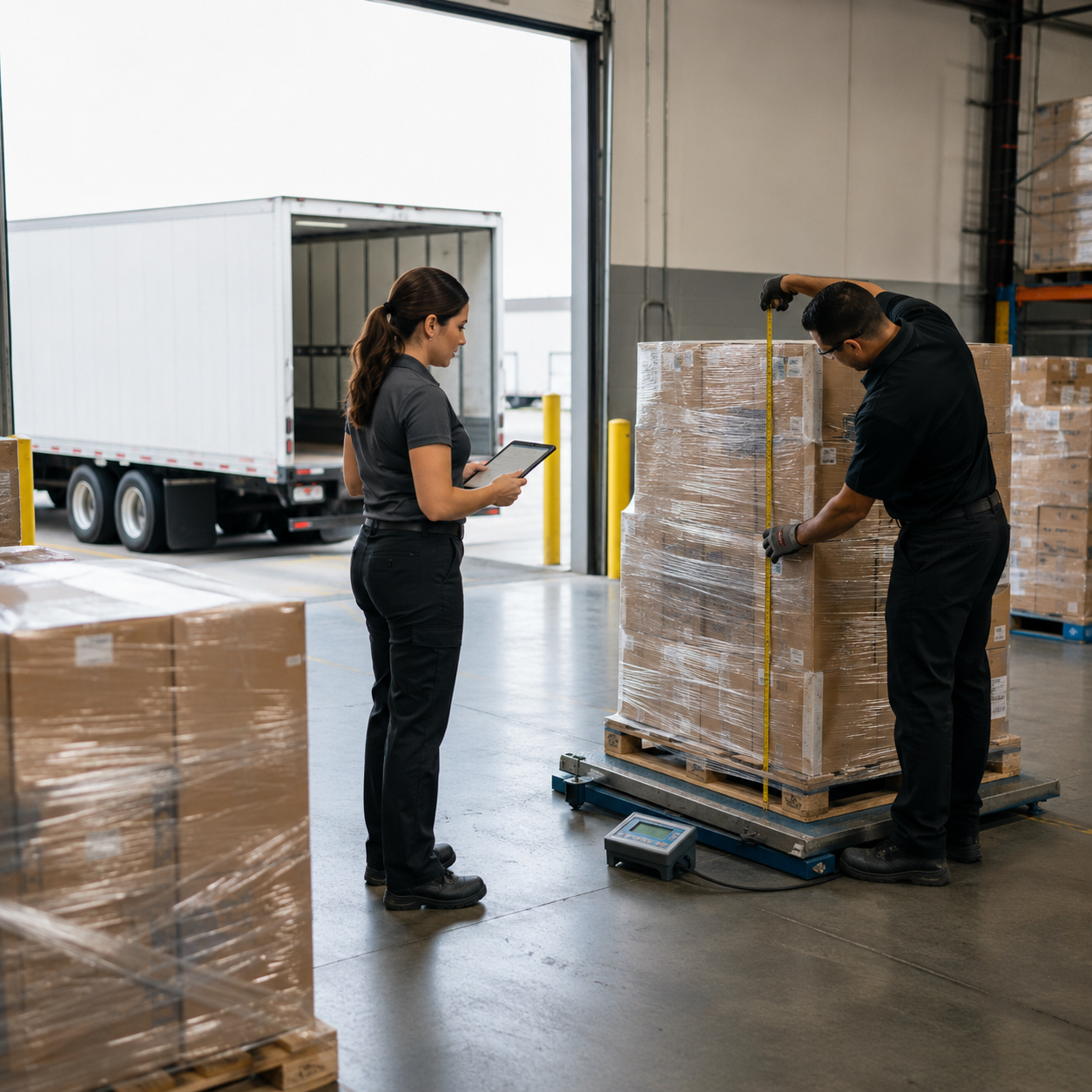
  • Weight & dimensions: Heavier and larger shipments cost more, and density (weight-to-volume ratio) is crucial. The overall shipment, including pallets or other packaging, is measured and weighed to determine its density. To calculate density, divide the total weight of the shipment by the total cubic feet. Here’s how to calculate the cubic feet and density of a shipment:LxWxH/1728 = Cubic Feet (CU FT)Weight (Pounds)/CU FT = Density (PCF)
  • Distance:The farther your freight needs to go, and the number of geographic zones or hubs it crosses, the higher the rate. Shipping cross-country will cost more than a regional haul.
  • Freight class: All LTL freight is assigned an industry-standard class (ranging from Class 50 for very dense items to Class 500 for very light or bulky items). This classification reflects the shipment’s density, value, stowability, and handling characteristics. Freight class directly impacts price. A lower class yields a lower price, and higher classes result in a higher cost to ship. Misclassifying an item can lead to surprise reclassification fees.
  • Accessorials: Any extra or special services required will add to the cost of your LTL shipment. For example, liftgate delivery, residential or limited-access drop-offs, inside delivery, expedited shipping, hazardous materials handling, and fuel surcharges are common LTL accessorial charges that increase the price.

High shipment volumes of dense, easy to handle shipments may allow negotiated contract rates or volume discounts. But fundamentally, weight, distance, class, and services determine LTL pricing. Ensuring shipments are properly measured, classified, and consolidated up front can help control costs.

Freight class is a standardized rating defined by the National Motor Freight Classification (NMFC) system. It categorizes freight based on its density, ease of handling, stowability, and liability. Classes typically range from 50 (very dense, hard-to-damage freight like metal hardware) up to 500 (bulky, lightweight, or fragile goods).

Carriers use freight class to set shipping rates, with lower classes generally costing less to ship per pound than higher classes. For example, dense freight in a lower class will be cheaper than an equal weight of bulky freight in a higher class. It’s important to get the class right: misclassifying freight can result in billing adjustments, delays, or penalties. Logistics teams should regularly consult NMFC guidelines or their 3PL to determine the correct class for each product. Proper classification ensures you’re billed accurately and avoids costly surprises.

There are strategies to save money and streamline LTL operations:

  • Consolidate shipments: Combine smaller orders into fewer, larger LTL shipments. Coordinating pickup schedules or using a central consolidation hub allows you to fill more of a trailer and benefit from better rates.
  • Classify and document accurately: Always provide precise weights, dimensions, and freight class inclusive of product, pallets, and packaging. Accurate freight information prevents re-weigh or reclass fees. Clear documentation (e.g., BOLs, labels) and early communication of special requirements can also reduce delays and unexpected charges.
  • Use technology and a TMS A transportation management system (TMS), like the C.H. Robinson customer platform, helps optimize routing, automate consolidation, shop rates across carriers, and route shipments to the right carrier based on parameters that meet cost and service metrics. TMS platforms with real-time tracking and analytics can identify performance issues and streamline shipping operations.

By consolidating freight, using accurate data, and embracing technology, shippers can significantly reduce costs and improve LTL shipping efficiency. Ready to get started? Connect with an LTL shipping expert today.

Selecting the right provider for your LTL freight is critical. Key considerations include:

  • Service network & capacity: Ensure the provider covers your shipping lanes and has the capacity to scale and evolve with your business.
  • Reliability and transit times: Choose providers that have the data to show strong on-time performance and low damage rates. Consistency matters as much as speed.
  • Pricing and contracts: Look for providers that provide competitive pricing based on your shipping needs.
  • Technology & visibility: A strong LTL provider will offer route guide capabilities, real-time shipment tracking, API or EDI integration, and actionable insights through analytics. System connectivity with your TMS or ERP is a major advantage.
  • Customer service & expertise: Dedicated support and deep logistics experience help mitigate disruptions and optimize performance.

LTL transit typically takes longer than full truckload (FTL) due to its shared, multi-stop hub-and-spoke structure. While FTL freight often moves directly from origin to destination, LTL shipments pass through regional terminals and may involve multiple stops and handling events.

A shipment that would take 1–2 days via FTL may take 3–7 days with LTL, depending on distance and the carrier’s network design. For time-sensitive freight, expedited LTL or volume partial truckload services can offer faster alternatives, though at a higher cost. Factor in LTL lead times during planning to meet service-level expectations.

live_help

Didn't find your answer?

Our customer service will be happy to help you.

Testimonials

Eric Bennett

Shipping Manager

Jason Miller

Warehouse Operations Manager

Daniel Foster

Distribution Manager